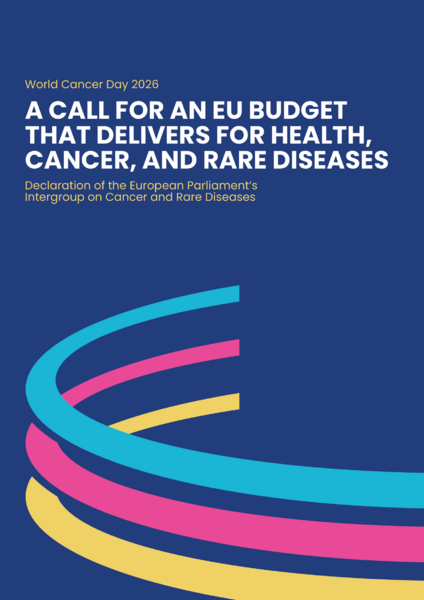
The Next EU Budget Risks Letting Cancer and Rare Disease Patients Down, MEPs Concerned
The members of the European Parliament Intergroup on Cancer and Rare Diseases issued a clear warning: without adequate funding for health, the significant progress made so far is at risk, as is the well-being of millions of citizens living with cancer or rare conditions, including children.
Cancer remains one of Europe’s most significant public health and economic challenges. Each year, 2.7 million people in the EU are diagnosed with cancer, and 1.3 million, including over 15,500 children and adolescents, die from the disease. In addition, more than 30 million Europeans live with a rare disease, 5.1 million of those being a rare cancer.
The impact extends far beyond health systems: OECD data show cancer accounts for €49 billion in productivity losses annually across the EU27. As more than 90% do not have any available treatment and patients typically wait 4–5 years for an accurate diagnosis, rare diseases also represent a significant yet often overlooked challenge for Europe.
When investment falls short, the consequences are borne not only by patients and families, but by Europe’s future workforce and innovation capacity.
In 2021, the European Commission launched Europe’s Beating Cancer Plan alongside the EU Cancer Mission, both landmark political commitments financed under the 2021-2027 Multiannual Financial Framework (MFF). Since then, the EU has made meaningful progress in cancer prevention, screening, care, workforce training, as well as in the recognition of the rights of people living with and beyond cancer.
Significant progress has also been made over the past twenty years to improve the lives of people living with rare conditions in the EU through crucial initiatives. These include the European Reference Networks (ERNs), improving access to specialised care, or the European Rare Diseases Research Alliance (ERDERA), helping to turn scientific research into tangible benefits for patients. Yet, people living with rare diseases are still waiting for a coherent EU framework for rare diseases, analogous to Europe’s Beating Cancer Plan.
The progress made so far now risks being weakened as negotiations begin on the EU’s next long-term budget for 2028-2034, where health, cancer and rare diseases face the prospect of reduced political and budgetary support.
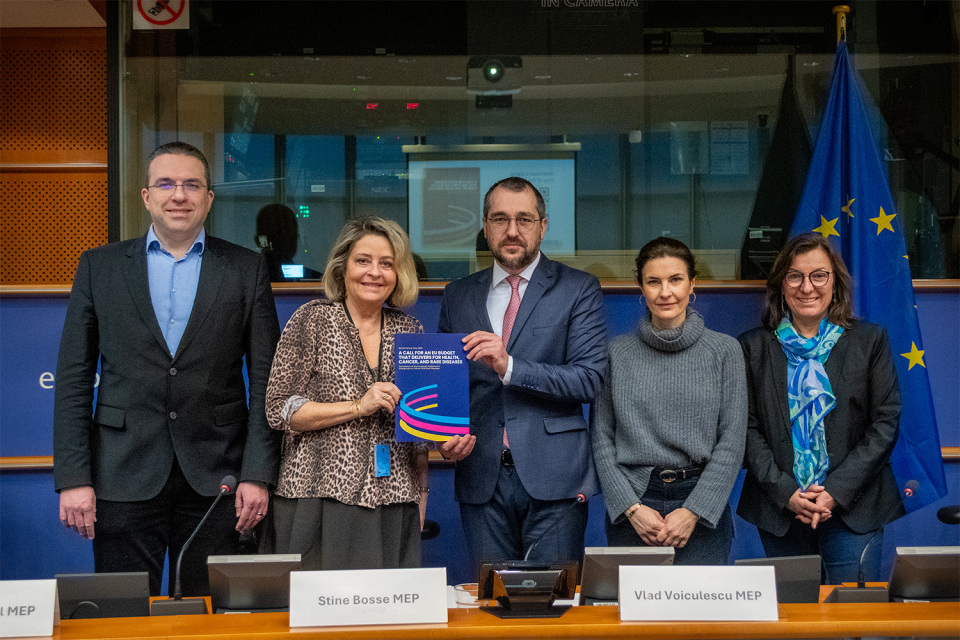
On the eve of World Cancer Day, Members of the European Parliament from across political groups are coming together to issue a joint declaration calling for a stronger, more explicit commitment to cancer and rare diseases in the next MFF, as a strategic investment in Europe’s people and productivity.
The declaration will be launched during a special event of the European Parliament Intergroup on Cancer and Rare Diseases at the European Parliament on Tuesday, 3 February, from 10:00 to 11:30 CET, in Room 5E2. The event, hosted by Vlad Voiculescu (RO/RE), brings together co-chairs of the Intergroup on Cancer & Rare Diseases, Stine Bosse (DK/RE), Tilly Metz (LU/Greens), Alessandra Moretti (IT/S&D) and Tomislav Sokol (HR/EPP).
The joint declaration sets out the following priorities:
- Ensure Health Remains a Key EU Priority in the Next MFF. The Intergroup warns that health risks being sidelined in the 2025 EU budget. A dedicated EU health programme, or at a minimum ringfenced funding, is essential to protect public health and support patient and civil society participation in policymaking.
- A dedicated European Cancer Fund of €2 billion in the next MFF is needed to deliver the full promise of the new actions and infrastructures for cross-border cooperation on cancer now established.
- Europe must bring greater coordination to cancer research. With the United States and China outpacing Europe in investment and innovation, the EU needs a clearer, more unified approach. A European Cancer Institute is one potential way to ensure stronger direction, accountability and long-term planning.
- The next MFF must help reduce the wide gaps in cancer outcomes across the EU. National and Regional Partnership Plans would support countries in modernising data systems, improving laboratory networks and training the workforce needed for advanced cancer care. ECO recommends recognising cancer care and broader health goals as explicit social objectives within the MFF and increasing funding for social objectives from 14% to 20%.
- Continue dedicated actions on childhood cancer to close remaining gaps. Childhood cancer remains a rare but high-burden disease with major survival and access inequalities across Europe. Children are not small adults; targeted EU funding, data-driven research, paediatric drug development, and dedicated care infrastructures are essential to close persistent gaps.
- Anchor Rare Diseases as an EU Priority. Rare diseases need explicit recognition in the EU budget. The next MFF should support an EU Action Plan to streamline diagnosis, care, research, and innovation, addressing the needs of 30 million Europeans while strengthening EU leadership in health and science.
- Secure Long-Term Support for Key EU Rare Disease Initiatives. The next MFF must ensure continuity and progress of EU initiatives addressing rare disease patient needs, including European Reference Networks, ERDERA, and JARDIN. Dedicated multiannual funding is needed for coordination, clinical guidelines, training, registries, and participation in the European Health Data Space, while EU instruments like the ECF should pilot joint procurement and solidarity mechanisms for orphan and advanced therapies.
 ‘Cancer is a leading cause of death in Europe, yet the MFF treats health funding as an afterthought. Our citizens deserve better’ said Intergroup Co-Chair, Vlad Voiculescu MEP.
 ‘Europe’s Beating Cancer Plan is a success story of EU health cooperation, and one that the EPP group remains proud to have delivered. Investing in cancer today is equally a health and competitiveness priority. By securing strong EU support for cancer in the next Multiannual Financial Framework, we can accelerate access to innovation and best care models, helping reduce productivity losses and strengthen our workforce, making Europe the global leader in the fight against cancer,’ adds Intergroup Co-Chair, Tomislav Sokol MEP.
 ‘Investing in cancer and rare diseases is an important choice for Europe’s future. With robust funding in the next Multiannual Financial Framework, we can drive innovation, support Europe’s biotech ecosystem and ensure people impacted by cancer and rare diseases benefit equally from medical progress. A strong EU health budget strengthens both patients’ lives and Europe’s long-term competitiveness,’ says Intergroup Co-Chair, Stine Bosse MEP
 ‘Action against cancer starts long before diagnosis. The link between health and the environment is undeniable: clean air, safe water and limits on harmful chemicals are central to prevention. This is why prevention must be strongly supported in the next long-term EU budget. This allows us to fully deliver on the prevention commitments made in Europe’s Beating Cancer Plan to build healthier, more resilient communities across Europe,’ says Intergroup Co-Chair, Tilly Metz MEP.
 ‘Too many people in Europe still find their prognosis after disease diagnosis determined by their social and economic status. Health equity must be explicitly at the heart of Europe’s future. The S&D Group stands for strong EU funding that tackles inequalities in prevention, screening, care and access to treatment across all Member States. With a health-focused budget, based on dedicated programs for health and research we can build a Europe where everyone benefits from high-quality and public healthcare services.’ says Intergroup Co-Chair, Alessandra Moretti MEP.