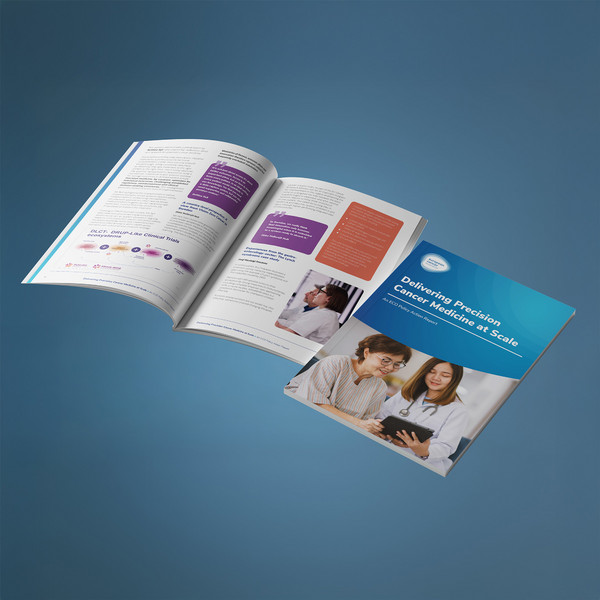
New ECO report calls for precision cancer medicine to move from innovation to implementation
The European Cancer Organisation has published a new policy action report, titled ‘Delivering Precision Cancer Medicine at Scale’, calling for stronger European action to ensure that advances in precision cancer medicine are translated into equitable patient access.
Precision cancer medicine is already changing cancer care. Advances in genomics, molecular diagnostics, biomarker-driven therapies, advanced diagnostics, imaging, image-guided local treatments and data-enabled clinical decision-making are helping to reshape how cancer is diagnosed and treated across Europe. Yet access to these innovations remains uneven. Too often, a patient’s ability to benefit from precision cancer medicine is still shaped by where they live, the capacity of their health system, the availability of molecular testing, reimbursement pathways, workforce expertise and the strength of local data infrastructure.
The report, developed following ECO’s Community 365 Roundtable on equitable access to precision cancer medicine, argues that Europe’s central challenge is no longer only scientific. The question is increasingly one of implementation. Europe already has many of the tools, technologies, clinical advances and policy frameworks needed to support wider access to precision cancer medicine. The priority now is to ensure that these advances can be delivered consistently, sustainably and fairly across European health systems.
The report highlights several key areas for action:
- Strengthening system readiness, including diagnostics, laboratory standards, digital infrastructure, data governance, reimbursement frameworks and sustainable financing models.
- Building stronger networks between cancer centres to support knowledge exchange, coordinated data collection, shared standards and more consistent access to expertise.
- Making better use of real-world data to support evidence generation, reimbursement decisions, innovation uptake and continuous learning across cancer care systems.
- Addressing delays in patient access to innovative technologies, with the report highlighting examples where reimbursement and availability decisions can take more than 500 days in some countries and more than 900 days in others.
- Sharing successful national and regional examples, including Sweden’s work on shared learning networks and national testbeds, England’s genomic laboratory infrastructure, the Netherlands’ use of multistakeholder expert groups, and IPO Porto’s precision oncology programme.
- Building on Europe’s Beating Cancer Plan, the EU Mission on Cancer and future EU investment discussions to reduce fragmentation and support long-term implementation.
'Precision cancer medicine is already changing what is possible in cancer care. The urgent task now is to make sure these advances are delivered consistently across health systems. That means strengthening cancer centre networks, improving access to molecular diagnostics and biomarker testing, and building more coordinated models of care so that patients can benefit from innovation wherever they live.'
Rui Medeiros
Deputy Director at the Research Centre, Instituto Português de Oncologia, IPO Porto, and Roundtable Co-Chair

'Equitable access to precision cancer medicine is not only about making new treatments available. It is about creating systems that can learn from every patient, generate robust real-world evidence and use that knowledge to improve outcomes. Europe has the scientific capacity and policy momentum to lead in this area, but this will require sustained commitment to implementation, data infrastructure and collaboration.'
Bettina Ryll
Lead of Work Package 6, Social Innovation for Access to PCM, PRIME-ROSE project, and Roundtable Co-Chair
The report calls for stronger collaboration between cancer centres, better integrated data and evidence infrastructures, more standardised approaches to implementation and continued EU support for precision cancer medicine as part of the future health policy agenda.